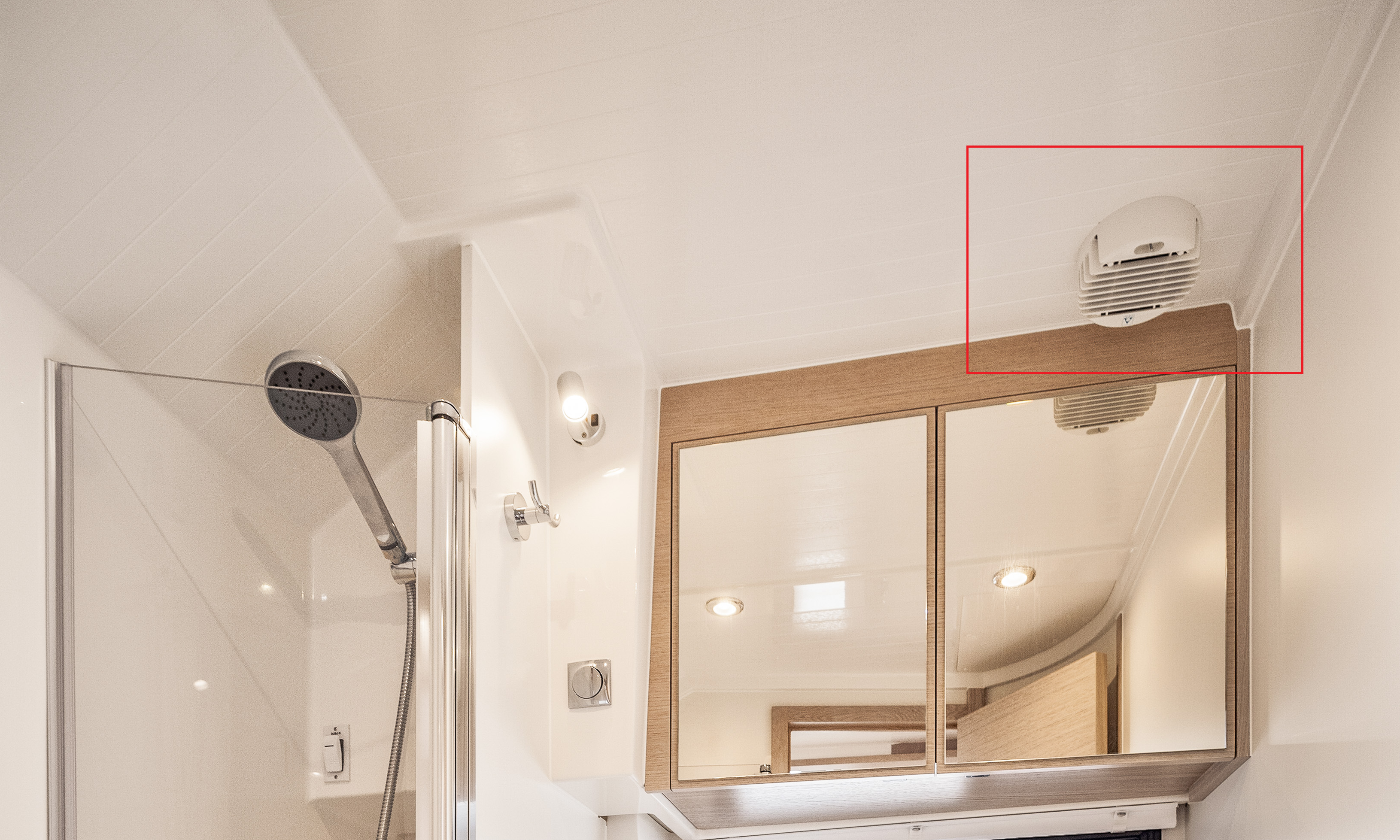
One of the things I noticed quite quickly is the wailing banshee noise the head extractor makes. It is so loud that you can not keep it on at night, and even during daytime you can hear it up in the saloon with the bathroom door closed. When the voltage changes because the onboard charger goes from e.g. float charging to absorption charging the noise also changes, which makes it double annoying.
However, if you are using the shower on the boat, you really want to keep the vent on most of the time, so the head has a chance to dry, otherwise the moisture accumulates endlessly.
Upon closer inspection, it’s just a standard 80x80x25mm fan wired up through a resistor to create the two speeds:
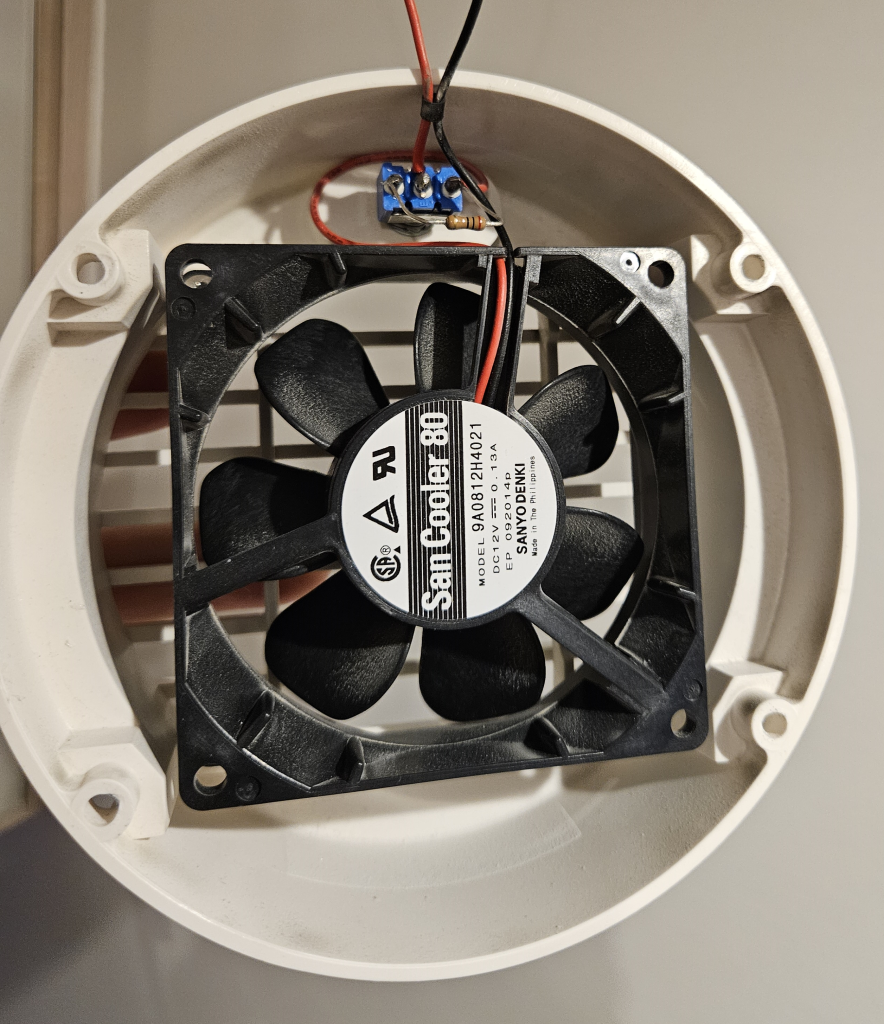
The fan is not any kind of special IP rated fan, but at least it’s a ball bearing fan and it’s not the cheapest one. The part number is 9A0812H4021 and looking up the stats it can move 61.8m3/min at 12VDC generating 29 dB of noise. Now 29 dB would not be so bad if it was very high frequency white noise (which is when the air hits the fan and the grille), as that noise does not travel very far and it would be enough to close the head door.
However, the fan creates a much lower pitched wailing sound, and because the fan is screwed directly to the shroud, and the shroud directly to the ceiling, the loud sound propagates everywhere.
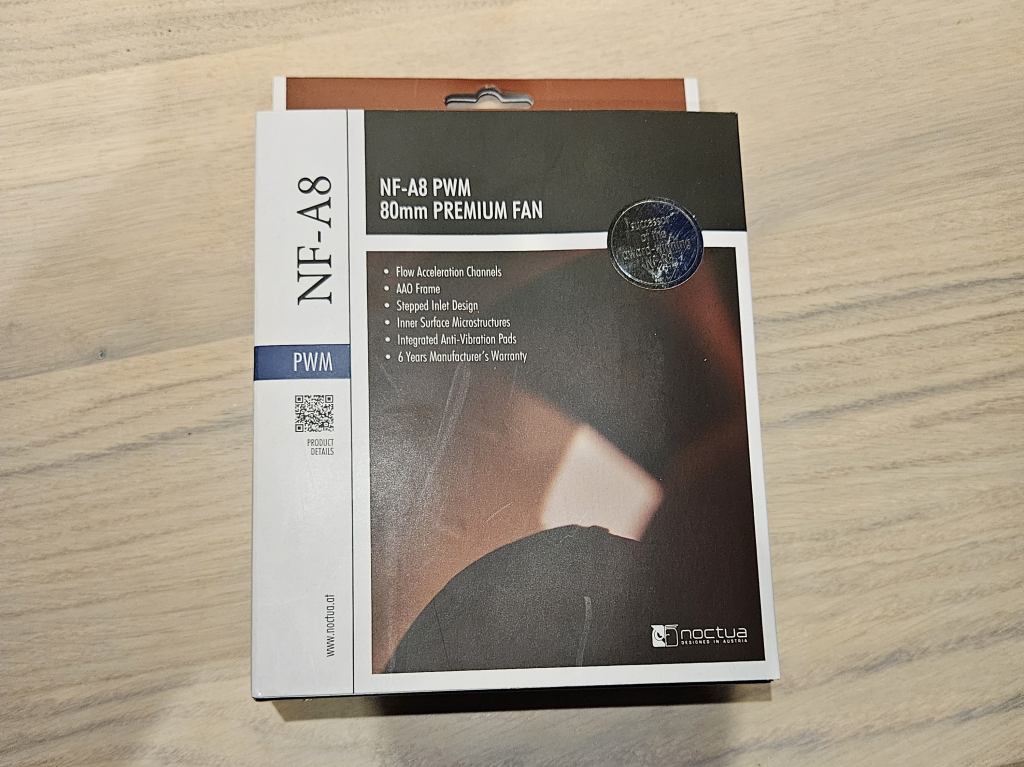
Since the fan has no IP rating anyway, I looked around a little in computer fans, and found out that Noctua makes a really nice 80mm fan, the NF-A8 PWM for just 20 EUR. PWM control itself is completely irrelevant, but the PWM variant has the highest airflow. At 55.5m3/h, it’s just a smidge less powerful than the original fan. The Noctua also creates a significantly lower static pressure, but because it’s blowing into an essentially open vent this is completely irrelevant. The noise level is just 17.7 dB (!) this means the fan is over TEN TIMES quieter, while moving just 10% less air. But who cares how much air something moves when it’s too damn loud to keep it on?
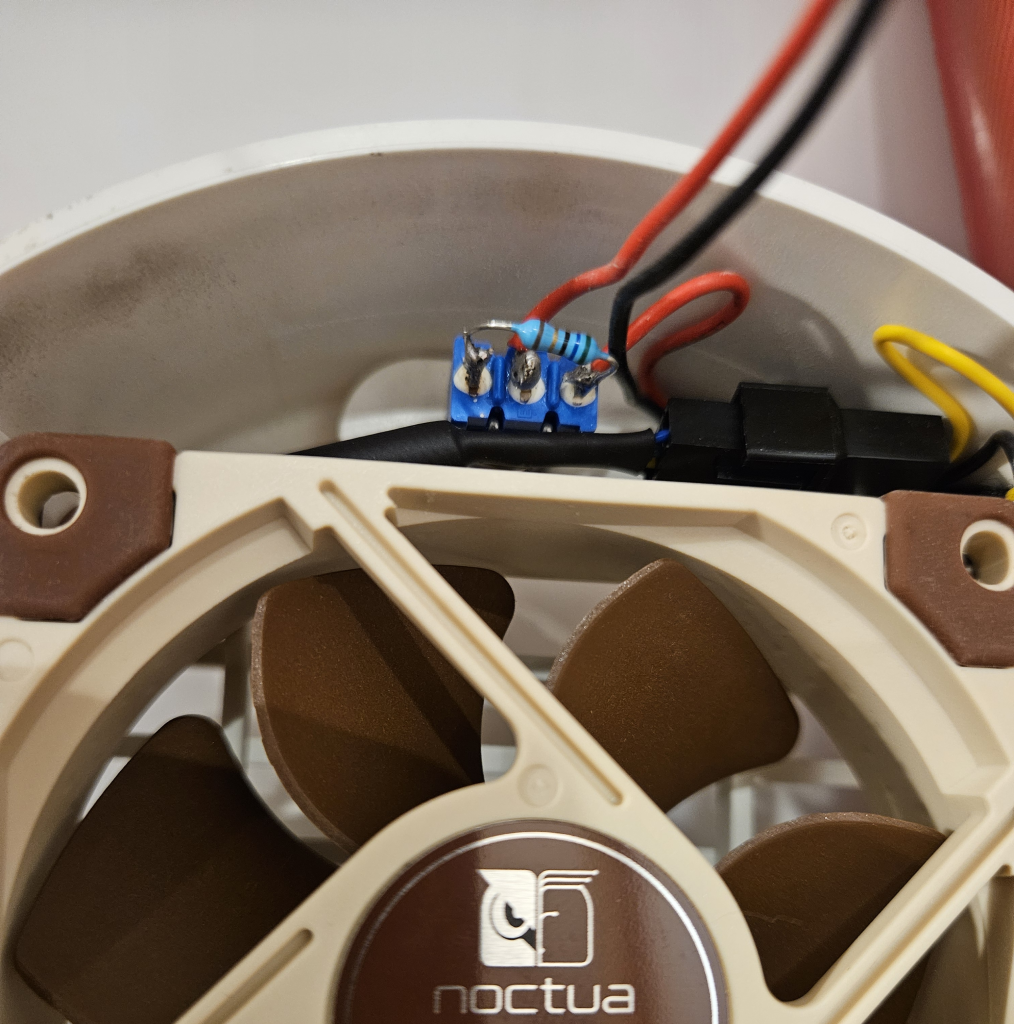
Since I was going to be using a computer fan anyway, I cannibalized one of the connectors in the box and soldered on a standard 4 pin fan header (with just the GND and 12V connected). The Noctua fan runs at max RPM if no PWM signal is detected and can also be voltage controlled (which is what the switch does through the resistor). Besides being much quieter by itself, the Noctua fan also has rubber gaskets, so it does not transfer as many vibrations. Here’s everything wired up (wires not taped up yet, so it is better visible what goes where):
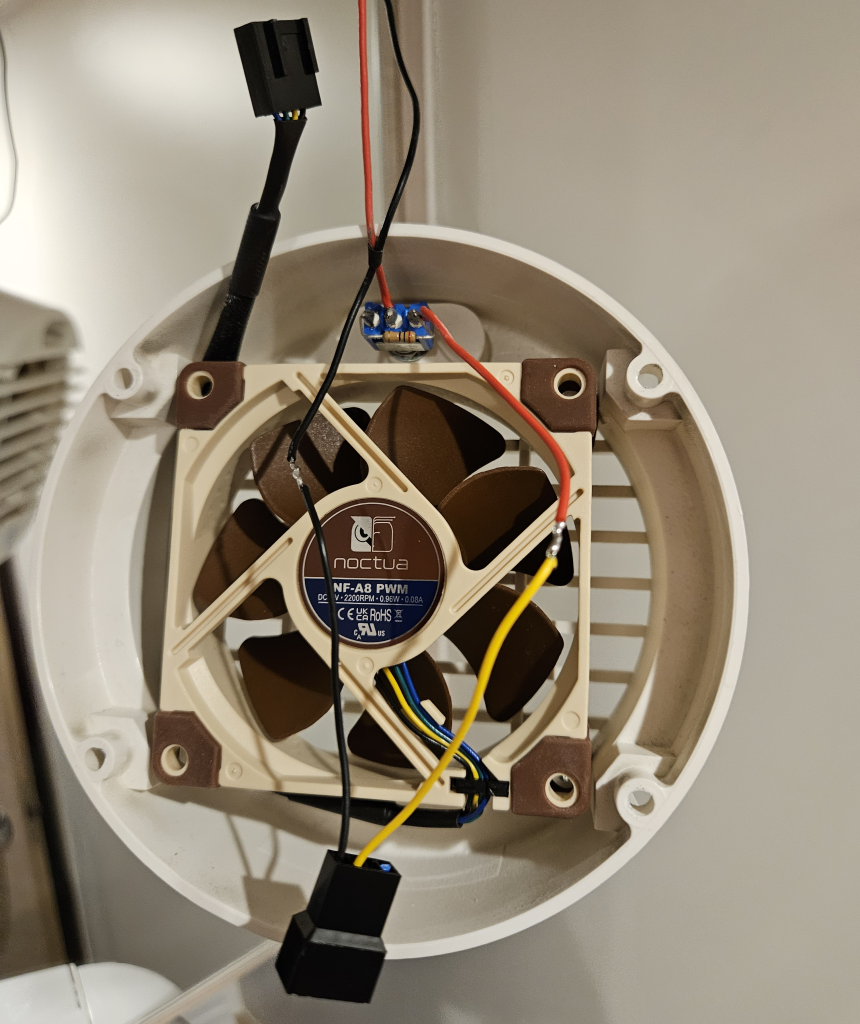
Since a resistor is used as a speed reducer, then it’s effect strongly depends on the current that the fan draws. The Noctua fan consumes about less than half the current of the original fan and the original resistor at 20 ohms does almost nothing to the speed at such low consumption, since the voltage drop is only about 1.2V compared to 2.6V with the standard fan.
Noctua themselves use a 50 ohm resistor inside an optional fan header to lower the maximum speed from 2200 rpm to 1750 rpm. I used a 60 ohm resistor I had lying around, 1/4 watt is enough. This drops the voltage by about 3.6V and is enough to have a noticeable effect on the fan speed:
The result?
If you close the door to the heads, then on the full speed you can hear a very faint buzz in the master cabin. On the lower speed it is almost inaudible, so you can easily keep it on all night. Inside the bathroom all you can hear is the air hitting the mesh even when running the fan at the higher speed.
I don’t know how the fan will hold up in a humid environment, but at least the replacement is now plug and play.